Free shipping in the continental U.S. and Hawaii!
Finding the right custom drapery shop near you starts with clarity about style, function, and the local services that ensure a perfect fit. This article teaches practical steps to define your personal drapery style, evaluate nearby custom drapery shops, compare fabric and hardware options, and understand why professional consultation and customization matter. Many homeowners struggle to translate room aesthetics and light-control needs into a concrete brief for a drapery specialist, which leads to delays, ill-fitting window coverings, or choices that look off once installed. This guide solves that problem by providing actionable checklists, measurement rules, fabric comparisons, and trend-versus-durability advice to help you find “drapery shops near” that match both taste and technical needs. You will learn how to articulate style (useful when searching for “custom drapery shops near me”), vet portfolios and reviews, choose appropriate fabrics and headings, and what to expect during a design consultation and installation. Each H2 section includes step-by-step guidance and quick-reference lists or tables so you can move from inspiration to an informed conversation with local window treatment companies.
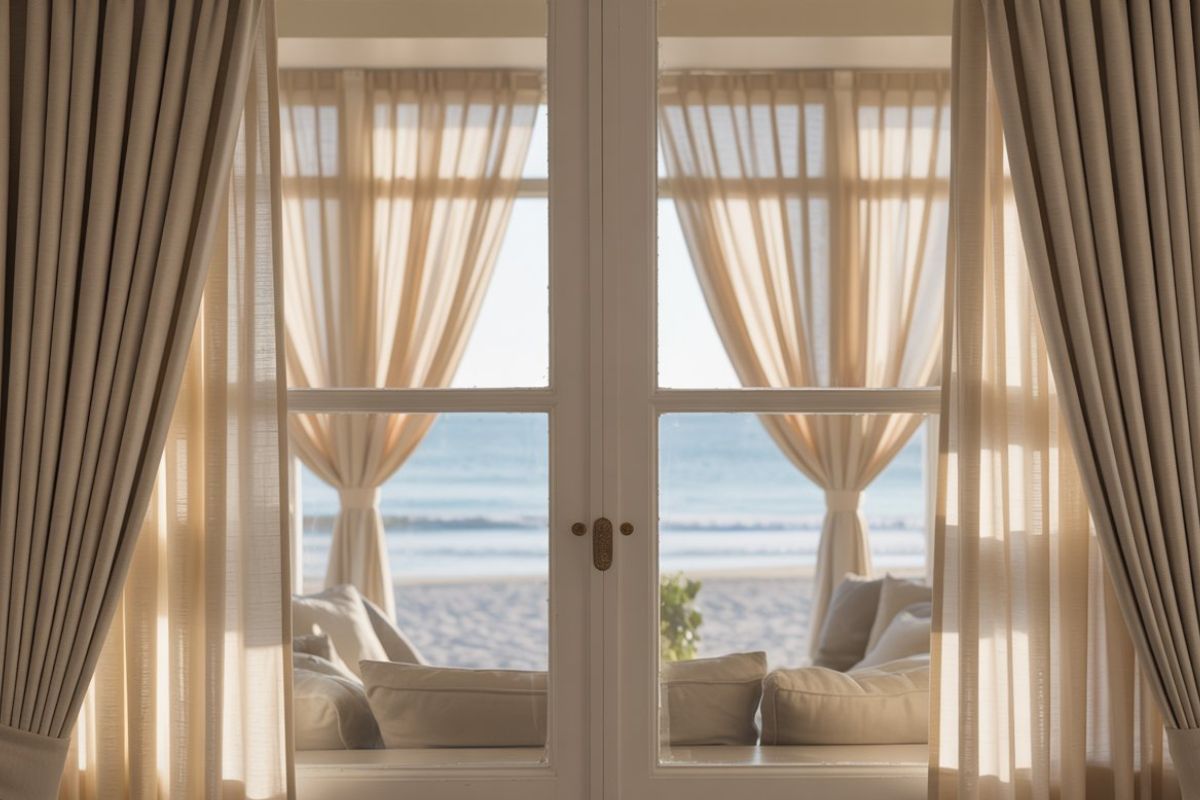
Defining personal style and functional needs starts by naming the aesthetic and the practical outcome you want from custom drapery, because clarity helps shops propose the right fabrics and headings. Identify whether your interior design style leans modern, traditional, minimalist, bohemian, or transitional and state the primary function—light control, privacy, thermal insulation, or sound dampening—so a vendor can match materials and construction to the goal. A clear style-function brief speeds the design consultation and narrows down choices among bespoke curtains, blinds, and motorized curtains where appropriate. The next step is to map specific drapery styles and functional priorities to rooms, which makes measurement and hardware decisions more straightforward and reduces rework.
Popular heading styles and fabric pairings help translate an interior design label into a visual result by linking form and finish to common room types. For example, Popular Pinch Pleat Drapes pair well with traditional or formal interiors where structured folds and classic fullness enhance symmetry, while grommet top drapes and ripple fold systems suit modern and minimalist spaces that value clean lines and ease of movement. Linen drapes with a relaxed header work for coastal or Scandinavian aesthetics, and heavy velvet pinch pleats add drama to formal living or dining rooms. Understanding these mappings makes it easier to ask a shop for specific hyponyms—like pinch pleat drapes or grommet top drapes—when requesting quotes and samples.
Functional needs directly determine fabric opacity, lining decisions, and whether layered window treatments are required, because each element affects light, privacy, and insulation. Sheer fabrics maximize natural light while preserving view and are ideal for living spaces, medium-weight weaves provide daytime privacy without full blackout, and blackout or heavy-lined fabrics serve bedrooms or media rooms where darkening is critical. Layering a sheer under heavier custom drapery or pairing shades with curtains offers both flexibility and aesthetic depth. These functional choices also influence hardware selection and installation height to optimize light control and privacy.
Different rooms have distinct priorities—privacy for bedrooms, acoustics and insulation for home theaters, style and light balance for living rooms—so custom drapery must be specified by room to perform well. Bedrooms typically require blackout or lined custom drapery for sleep quality and privacy, while living and dining areas often prioritize light diffusion and refined textures like silk blends or linen for visual warmth. Home offices benefit from layered window treatments or motorized curtains to reduce glare and support productivity, and kitchens may prioritize easy-care synthetics or blends that tolerate higher humidity. Room-specific priorities determine both fabric types and heading styles, guiding the measurement and hardware decisions that follow.
Finding and evaluating local custom drapery shops combines targeted local search tactics, portfolio assessment, and a structured set of questions to distinguish full-service providers from basic fabric sellers. Start with geolocated search phrases such as “custom drapery shops near me” or “local window treatment companies” and inspect map listings for service pages, project photos, and response patterns that indicate active client support. Use the portfolio and review rubric below to shortlist shops, then prepare a focused set of questions covering measurement, lead times, warranties, motorization, and aftercare to confirm fit. Verifying consultation and installation services during vetting ensures the quoted price covers both design guidance and professional Installation, reducing the risk of DIY errors.
Effective searches use phrase variations and platform filters that surface specialist results rather than mass retailers, because specific search queries reveal shops with portfolio depth and service descriptions. Use queries like “custom drapery shops near”, “drapery shops near me”, and “local window treatment companies” on map services and directories, filter for providers with recent photos of installed projects, and check for detailed service pages describing bespoke curtains, drapes, blinds, and shades. Look for shops that show measurement and installation processes—this signals they offer end-to-end service rather than only selling fabric. These signals guide the next step: examining reviews and portfolios to assess craftsmanship and reliability.
After narrowing options, evaluate portfolios and reviews to confirm workmanship and continuity of service.
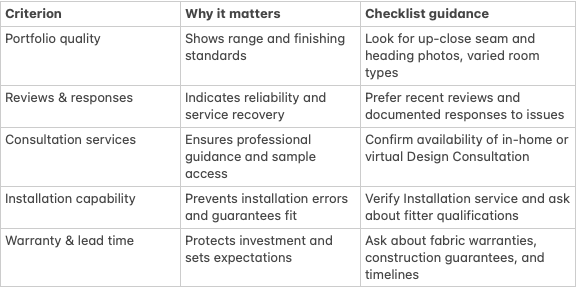
Assessing reviews and portfolios requires a rubric that weighs recent installation photos, diversity of rooms, and the presence of close-up shots showing seams and heading details, since these elements reveal craftsmanship. Focus on portfolios that include finished-room shots, installation photos, and different heading styles to confirm the shop’s ability with pinch pleats, grommets, ripple fold systems, and motorized curtains. Read reviews for comments about punctuality, measurement accuracy, and aftercare, and note whether a shop responds to feedback—response patterns indicate customer service. Use the evaluation table below as a quick checklist when comparing providers.
Shop Evaluation Table: practical criteria to vet local drapery specialists and why each matters.
Preparing a focused set of questions lets you compare providers on the same criteria and highlights those offering full-service support rather than only materials. Ask about fabric sourcing and whether the shop can provide sample swatches and fabric technical sheets detailing opacity and care. Confirm the measurement process: will a professional take final measurements, and are allowances and mounting height included in the quote? Inquire about Installation: do they offer professional Installation, what hardware options are available, and are motorization systems supported? Finally, ask about timelines, lead times, warranties, and how the shop handles pattern matching and pleat alignment to ensure a precise outcome.
1. Do you provide a Design Consultation and sample swatches in-home or virtually?
2. Who performs final measurements and will you handle Installation?
3. What are lead times, warranties, and your policy for defects or rework?
Asking these questions reduces surprises and connects you to shops prepared to manage both design and Installation.
Choosing fabric and hardware centers on matching material properties to the functional needs of the room and the visual style of the interior, because fabric fiber, weight, and care define drape behavior and longevity. Consider natural fibers like linen and silk for breathability and aesthetic texture, synthetic blends for durability and easier care, and heavy velvets where insulation and sound dampening are priorities. Hardware choices—rod versus track, finial style, and finishes—affect both performance and proportion; for example, tracks and ripple fold systems favor sleek modern looks and motorization compatibility, while rods with decorative finials complement traditional pinch pleats. Local custom drapery shops and window treatment providers typically provide sample swatches, tailored fabric sourcing, and hardware matching services to align fabric choices with the correct rod/track hardware.
Fabric comparison table: compare fabric type, opacity/weight, and care to guide selection based on function.
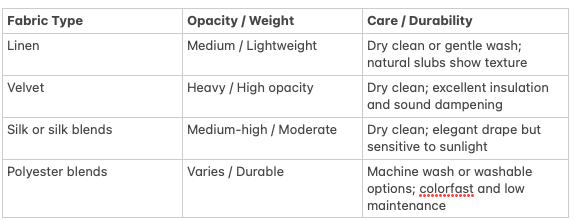
This table clarifies trade-offs so you can choose fabrics that meet both appearance and maintenance expectations, which helps determine heading style and hardware scale.
Fabric type controls drape quality, opacity, and maintenance needs, so selecting the right fiber aligns aesthetics with room performance. Natural fibers like linen offer soft, breathable folds and a relaxed visual suited to casual, modern, or coastal interiors, while silk and silk blends provide a lustrous finish that elevates formal rooms but require careful maintenance. Velvet and heavy weaves increase thermal insulation and reduce reverberation in living spaces or bedrooms where sound dampening matters. Synthetic and blended fabrics provide resilient, washable options for high-traffic rooms and are often selected where humidity or ease of cleaning is a priority.
Heading styles—pinch pleat, grommet, rod pocket, and ripple fold—directly influence the silhouette and perceived formality of window treatments by shaping fullness and movement. Pinch pleat drapes create structured, tailored folds that read as classic and formal, making them ideal for dining rooms and traditional spaces, whereas grommet top drapes produce even, contemporary waves suited to modern interiors. Ripple fold systems and track-mounted headings deliver consistent vertical lines and are often chosen for motorized curtains because they glide smoothly. Selecting a heading style impacts fabric consumption, pleat spacing, and the hardware required for proper operation.
Hardware selection balances proportion, finish, and function so that rods, tracks, and accessories support the drapery visually and mechanically, because oversized rods or undersized brackets can undermine an otherwise well-specified treatment. For large windows choose a larger-diameter rod or a robust track; select finial styles and metal finishes that echo room finishes—brushed nickel for modern, antique brass for traditional. For motorized custom drapes prioritize a track system rated for motorization and verify that the motor supports the fabric weight. Proper bracket placement, rod projection, and track mounting locations also ensure full travel and correct stack-back, which leads into why professional measurement and consultation are important.
Reasons to Choose Custom Drapes Online are clear when you consider that consultation and customization are essential because professional guidance translates style and function into precise materials, construction details, and hardware that achieve the intended result. A design consultation provides sample swatches, technical fabric information, and expert recommendations on heading styles and hardware, ensuring choices align with room needs and aesthetic goals. Accurate measurements and custom construction prevent common pitfalls—incorrect length, inadequate fullness, or poor pattern matching—that often result from DIY approaches. Beyond fabric selection, customization includes linings, interlinings, pleat-to-pattern matching, and motorization options that improve performance and longevity.
A typical design consultation begins with a review of the room and goals, followed by selection of fabric swatches, heading demonstrations, and a discussion about light control, privacy, and motorization if desired. The consultant should take preliminary measurements, advise on mounting options and hardware finishes, and provide a timeline and estimate for fabrication and Installation. Expect deliverables such as a fabric recommendation, sample swatches for final approval, and a proposal that outlines lead times and warranty terms. Clear documentation and a plan for final measurement and Installation reduce the risk of errors and ensure final results match expectations.
Accurate measurements determine width, length, and mounting height so drapery hangs and functions correctly, because small errors in allowances or mounting positions create visible fitting issues. Professionals follow rules—measure the full window plus recommended overhang for stack-back, specify rod or track placement above the frame for perceived height, and factor in hem allowances and heading fullness. Common mistakes include relying on rough measurements or using finished window dimensions without allowance for movement, which professional measurers avoid by taking final site measurements prior to fabrication. Proper measurement directly supports successful Installation and long-term performance.
Customization extends beyond fabric selection to features that improve performance and personalization, including linings and interlining for insulation, pleat-to-pattern matching for printed fabrics, and motorization systems for convenience and smart-home integration. Lining choices affect opacity and thermal performance; interlinings add weight and insulation for cold climates or high-glare conditions. Motorized curtains and automated tracks enable remote control and integration with lighting schemes, useful in home theaters or smart homes. Discussing these options during the Design Consultation allows a shop to propose custom drapery construction and compatible hardware that meet both aesthetic and functional priorities.
Read More: Pinch Pleat Curtains with Hooks: Pros and Cons of Store Bought and Custom Made Drapes
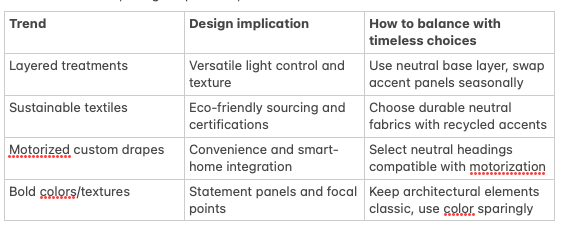
Staying current with trends while investing in durable construction lets you refresh interiors without sacrificing lasting value, because the right mix of trend elements and classic foundations preserves resale appeal and long-term performance. Current trends for 2025–2026 include layered treatments that combine sheers with heavier drapes, bolder color accents used as statement panels, a rise in sustainable textiles and certifications, and increased interest in motorized custom drapes for convenience. To ensure longevity, prioritize seam construction, quality linings, robust hardware, and maintenance-friendly fibers. Balancing trend adoption with timeless base elements creates versatile window treatments that evolve with décor.
Key trends emphasize both functionality and expressive design, so choices should reflect room use and durability needs rather than fleeting fashion alone. Layered window treatments combine sheer and opaque layers to give flexible light control and visual depth, while bolder jewel tones and textured weaves add focal interest to neutral backdrops. Sustainability is a growing priority, with more homeowners selecting eco-friendly fabrics and recycled-content fibers, and motorized curtains are increasingly specified for convenience and energy management. Incorporating these trends responsibly often means choosing neutral foundational fabrics and adding trend-forward accents that can be refreshed at lower cost.
Trend table: trends, design implication, and how to balance with timeless choices.